Sunday, March 6, 2011

"We must close union offices......

We must close union offices, confiscate their money and put their leaders in prison. We must reduce workers salaries and take away their right to strike."--Adolph Hitler, May 2, 1933
400 Americans have more wealth than half of all Americans combined.
Michael Moore Marches Into Wisconsin and Burns Down The Big Budget Lie
March 5, 2011
By Jason Easley and Sarah Jones
People were crowded around Fire Station No. 1 in Madison, Wisconsin around 1:30 central time this afternoon, eagerly awaiting the arrival of filmmaker Michael Moore who flew to Madison, Wisconsin to support the Worker’s Rights Rally. Yup, Mike’s in the House.
The uplifting theme of today’s Worker’s Rights Rally in Wisconsin was, “We Are Wisconsin and We Are Winning.” An enthusiastic crowd, undaunted by a week of Governor Walker’s and the Republicans’ attempts to shut them down and shut them out, chanted, sang and marched around the rotunda of the Capitol. And then came the word that a very special guest would be surprising them.
Michael Moore began by reading his statement called America is not broke, “America is not broke. Contrary to what those in power would like you to believe so that you’ll give up your pension, cut your wages and settle for the life your great grandparents had. America is not broke. Not by a long shot. The country is awash in wealth and cash. It’s just that it is not in your hands.”
He then called the great conservative redistribution of America’s wealth a heist, “It has been transferred in the greatest heist in American history from the workers and consumers to the banks and portfolios of the uber-rich. Right now this afternoon just 400 Americans have more wealth than half of all Americans combined. Let me say that again, and please someone in the mainstream media, just repeat this fact once. We’re not greedy. We’ll be happy to hear it just once. 400 obscenely wealthy individuals, 400 little Mubaraks, most of whom benefited in some way from the multi-trillion dollar taxpayer bailout of 2008 now have more cash, stock, and property than the assets of 155 million Americans combined.”
Moore said, “I have nothing more than a high school education, but Gov. Walker back when I was in school every student had to take one semester of economics in order to graduate, and here is what I learned. Money doesn’t grow on trees, unless it’s a palm tree. It grows when we make things. It grows when we have good jobs with good wages that we use to buy the things that we need, and guess what? That creates more jobs.”
He continued, “It grows when we provide an outstanding education system. An educational system that then grows a new generation of entrepreneur, inventors, scientists, thinkers. The people who will come up with the next great idea for this planet, and those ideas create jobs, and the jobs produce tax revenue, but the few who have the most money don‘t want to pay their fair share of the taxes.”
Moore spoke about how the rich tax dodgers crashed our economic system, “They’d rather invest it in a gambling casino known as Wall St. betting for or against the stock market or against your home mortgage, and the entire population suffers because that wealth has been removed from circulation. What’s so cynical about this is that the very people who don’t pay their taxes crashed our economic system. They created the unemployment which has cost us tax revenue and states like Wisconsin have ended up with a so called budget crisis, but Wisconsin is not broke.”
Michael Moore called the Wisconsin budget crisis one of the three biggest lies of the last decade, ” What are three biggest lies of the last decade? Let’s repeat them. Number one Wisconsin is broke. Number two there’s weapons of mass destruction in Iraq, and number three the Packers needs Farve to win the Super Bowl. The nation is not broke, my friends. There’s lots of money to go around, lots, lots. It’s just that those in charge have diverted that wealth into a deep well that sits in their well-guarded estates. They know. They know. They have committed crimes to make this happen.”
Moore did something brilliant. He shifted the narrative. Republicans want the Wisconsin story to be about the budget. Early on Democrats were focused on the issues of liberty and collective bargaining. Moore broadened the message and created a third narrative about how decades of pro-corporate and pro-wealthy economic policies have redistributed the nation’s wealth from the people to a small group of super-rich haves. This is the story that terrifies both conservative politicians and the network of billionaire wealth that owns them.
Wisconsin isn’t only about freedom unions and collective bargaining. At a deeper level, Wisconsin is about the systemic redistribution of wealth that the Republican Party has overseen since 1980. It is about creating an economic caste system where the rich always stay rich and rest of us are destined to serve them. Conservatives have expertly hid their true motives for years with distractions like the culture wars, and sometimes shooting wars like in Iraq. While America was focusing on the terror alert level, George W. Bush was picking up the mantle of Ronald Reagan and redistributing wealth.
If Republicans and their puppet masters are successful in breaking the back of organized labor then millions of Americans will be returned to a form of economic serfdom that was once thought to have been banished decades ago.
Wisconsin is the battle field and unions are our last line of defense, and nothing less than economic liberty, and the American Dream hinge on the outcome.
http://www.politicususa.com/en/michael-moore-wisconsin-rally
March 5, 2011
By Jason Easley and Sarah Jones
People were crowded around Fire Station No. 1 in Madison, Wisconsin around 1:30 central time this afternoon, eagerly awaiting the arrival of filmmaker Michael Moore who flew to Madison, Wisconsin to support the Worker’s Rights Rally. Yup, Mike’s in the House.
The uplifting theme of today’s Worker’s Rights Rally in Wisconsin was, “We Are Wisconsin and We Are Winning.” An enthusiastic crowd, undaunted by a week of Governor Walker’s and the Republicans’ attempts to shut them down and shut them out, chanted, sang and marched around the rotunda of the Capitol. And then came the word that a very special guest would be surprising them.
Michael Moore began by reading his statement called America is not broke, “America is not broke. Contrary to what those in power would like you to believe so that you’ll give up your pension, cut your wages and settle for the life your great grandparents had. America is not broke. Not by a long shot. The country is awash in wealth and cash. It’s just that it is not in your hands.”
He then called the great conservative redistribution of America’s wealth a heist, “It has been transferred in the greatest heist in American history from the workers and consumers to the banks and portfolios of the uber-rich. Right now this afternoon just 400 Americans have more wealth than half of all Americans combined. Let me say that again, and please someone in the mainstream media, just repeat this fact once. We’re not greedy. We’ll be happy to hear it just once. 400 obscenely wealthy individuals, 400 little Mubaraks, most of whom benefited in some way from the multi-trillion dollar taxpayer bailout of 2008 now have more cash, stock, and property than the assets of 155 million Americans combined.”
Moore said, “I have nothing more than a high school education, but Gov. Walker back when I was in school every student had to take one semester of economics in order to graduate, and here is what I learned. Money doesn’t grow on trees, unless it’s a palm tree. It grows when we make things. It grows when we have good jobs with good wages that we use to buy the things that we need, and guess what? That creates more jobs.”
He continued, “It grows when we provide an outstanding education system. An educational system that then grows a new generation of entrepreneur, inventors, scientists, thinkers. The people who will come up with the next great idea for this planet, and those ideas create jobs, and the jobs produce tax revenue, but the few who have the most money don‘t want to pay their fair share of the taxes.”
Moore spoke about how the rich tax dodgers crashed our economic system, “They’d rather invest it in a gambling casino known as Wall St. betting for or against the stock market or against your home mortgage, and the entire population suffers because that wealth has been removed from circulation. What’s so cynical about this is that the very people who don’t pay their taxes crashed our economic system. They created the unemployment which has cost us tax revenue and states like Wisconsin have ended up with a so called budget crisis, but Wisconsin is not broke.”
Michael Moore called the Wisconsin budget crisis one of the three biggest lies of the last decade, ” What are three biggest lies of the last decade? Let’s repeat them. Number one Wisconsin is broke. Number two there’s weapons of mass destruction in Iraq, and number three the Packers needs Farve to win the Super Bowl. The nation is not broke, my friends. There’s lots of money to go around, lots, lots. It’s just that those in charge have diverted that wealth into a deep well that sits in their well-guarded estates. They know. They know. They have committed crimes to make this happen.”
Moore did something brilliant. He shifted the narrative. Republicans want the Wisconsin story to be about the budget. Early on Democrats were focused on the issues of liberty and collective bargaining. Moore broadened the message and created a third narrative about how decades of pro-corporate and pro-wealthy economic policies have redistributed the nation’s wealth from the people to a small group of super-rich haves. This is the story that terrifies both conservative politicians and the network of billionaire wealth that owns them.
Wisconsin isn’t only about freedom unions and collective bargaining. At a deeper level, Wisconsin is about the systemic redistribution of wealth that the Republican Party has overseen since 1980. It is about creating an economic caste system where the rich always stay rich and rest of us are destined to serve them. Conservatives have expertly hid their true motives for years with distractions like the culture wars, and sometimes shooting wars like in Iraq. While America was focusing on the terror alert level, George W. Bush was picking up the mantle of Ronald Reagan and redistributing wealth.
If Republicans and their puppet masters are successful in breaking the back of organized labor then millions of Americans will be returned to a form of economic serfdom that was once thought to have been banished decades ago.
Wisconsin is the battle field and unions are our last line of defense, and nothing less than economic liberty, and the American Dream hinge on the outcome.
http://www.politicususa.com/en/michael-moore-wisconsin-rally
Coal Reignites A Mighty Battle Of Labor History
by NPR Staff
The protests in Wisconsin may be a big turning point for organized labor in America. It's not yet clear whether Wisconsin Gov. Scott Walker's plan to end state workers' collective bargaining power will destroy the unions in his state or whether it will actually re-energize them — both in Wisconsin and nationally.
What is clear is that we're all spectators in a pretty significant chapter of history: the history of organized labor in America.
And recently, we went to a place that can probably be described as a kind of Bastille or Lexington and Concord of that history.
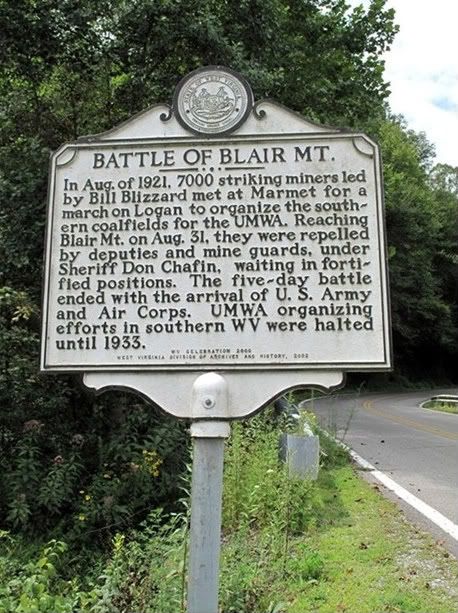
It's called Blair Mountain, and it's located in a southern pocket of West Virginia.
In late summer 1921, Blair Mountain was the site of the largest uprising in American history since the Civil War. It was the only time in history that U.S. air power has been used against American civilians.
"This is what's left of the town of Blair," Kenny King tells Weekends on All Things Considered host Guy Raz, as they stand next to a stream. "There, maybe, I think I counted maybe about 35 houses left."
King is a third-generation coal man. His grandfather and father were miners. King himself works as a chemical analyst for a coal company.
And here in Blair, in Logan County, W.Va., well, is the heart of coal country.
"It's been underground mined a lot, but there's still quite a bit of coal left," King says. "Yeah, there's millions of tons, I'd say, in that area."
A Coal-Fired Country
West Virginia's been called the Saudi Arabia of coal. It produces more than a third of all the coal mined in the U.S. More than half the energy Americans use is powered by burning those black rocks. The lights in your house, your TV, maybe the computer you're reading this story on — they all work thanks to coal.
The other thing about West Virginia is its poverty rate, one of the highest in America, even though coal prices just hit a 15-year high.
Almost a quarter of the people in Logan County live below the poverty level. They're people left behind by the changes in technology and technique that have allowed coal companies to earn more money and hire fewer miners.
This story, though, is only partially about jobs. It's really about history — the battle over what to remember and whether to remember it at all.
A Firefight To Organize
No one has the exact details of what happened here in late August/early September 1921, but the basic story says around 10,000 coal miners took up arms against the private militias employed by West Virginia's Stone Mountain Mining Co. For five days they fought for the right to organize — to join unions.
"From all the artifacts found here, there had to be hundreds of men up here," King says. "I mean, there's probably thousands of shell cases scattered around here."
As many as 100 men died in the fighting. It got so bad that President Harding sent a detachment of federal troops to crush the rebellion.
None of this happened in a vacuum. Tension had been building for years. Just a year before, union-busting mercenaries, who worked for a private agency called Baldwin-Felts, shot and killed the pro-union mayor of the nearby town of Matewan.
At the time, most states had laws against organizing. It didn't help that Harding's administration was decidedly anti-labor.
The worry was the unions would bog down industry and put the brakes on America's rapid economic growth.
The problem for the wage earners, at least in Logan County, was that they didn't have a whole lot of options.
A Company Town
"They had the yellow-dog contract which said that, basically, if you took a job at this mine, you could not associate with anyone in the union, you couldn't join," says Doug Estepp, a local historian who runs tours of the area. "You were basically fired, blacklisted and evicted — and probably beaten on the way out by the guards just for good measure."
The coal companies owned your house, they paid you in credits that could only be spent on highly inflated food at the company-owned store, and if you complained about safety, you were fired.
The private security men from Baldwin-Felts would threaten, beat and sometimes murder agitators — all with impunity.
And so it all came to a head in late August 1921. The miners of Logan and Mingo counties had had enough.
Back in the '70s, a documentary called Even the Heavens Weep featured a few of the survivors of the battle, including Paul Maynard.
"I don't know, there was thousands around here, but they was coming in from Illinois, Pennsylvania and Ohio, the miners was," Maynard said. "They told the government that if they didn't open up Logan County, that they was gonna open it up themselves and blow it away."
Although the workers outnumbered the coal company guards, they were also outgunned.
"They were facing big odds. The coal operators had machine guns, they had tommy guns, a lot of high-powered rifles. They even had a small artillery piece up on one of the mountains here — we're not sure where," Estepp says.
After five days, the rebellion was crushed. Hundreds of workers were tried for insurrection and treason. The legal fees bankrupted the United Mine Workers Union, and for the next decade, it almost disappeared.
A Historic Site? Some Object
Every few weeks, King comes up here with his metal detector to find spent bullet casings. More than a million rounds were fired in those five days. And every time he's up here, King finds them.
Two years ago, Blair Mountain was entered into the National Register of Historic Places. And then, just a few months later, it was taken off by state officials.
Lawyers hired by West Virginia's largest coal companies came up with a list of landowners who, they said, objected to the designation.
"There's apparently a lot of money to be made by blowing this mountain up and taking all the coal out from it," labor historian Gordon Simmons says, referring to mountaintop removal.
A lot of the land around Blair Mountain is owned by coal companies, including the biggest ones, Massey and Arch. For now, the state hasn't given permission to mine this immediate area. But, judging by the number of tractors and heavy machines already deployed here, preservationists like King think it's just a matter of time.
"They already approved that area over there," King gestures. If it's not designated as a national historic site, he says, the spot where we're standing will be turned into a flat, grassy field.
King believes this is hallowed ground, like Gettysburg or the Edmund Pettus Bridge in Selma, Ala., places where America's history was forever changed. But he's had a hard time making that case to the folks in Logan County — a place where every fourth person is out of work.
'That's All I'll Ever Know'
At the Go-Mart gas station, about four miles from the mountain, mine workers stop by to grab pizza and hot dogs before heading off to the night shift.
There are only about 16,000 miners in West Virginia today. Mountaintop removal doesn't require as much manpower as underground mining. These are coveted jobs; they pay well. So for the most part, miners are more interested in seeing the economy grow than preserving what they see as just another mountain.
One 22-year-old named Jordon sums up the consensus view around here: "We got to mine the coal to make the money. Period. That's all there is to it," he says. "I've been around this my entire life. My dad was a strip miner, my grandfather was — that's all I've known, that's all I'll ever know."
About a 90-minute drive from Logan County, at the ornate state Capitol in Charleston, Simmons is part of a group trying to get Blair Mountain back onto the National Register. He says the struggle isn't only about jobs and mining rights. It's also about whether to remember Blair Mountain or to sweep it under the rug.
Just as in 1921, Simmons says, when West Virginia's political establishment was wholly controlled by coal interests, "things haven't changed that dramatically, that the long arm of King Coal can't reach into state government and make things happen in its favor."
Just this week, West Virginia's historic preservation office started the process to get Blair Mountain back on the National Register. Landowners have until April 1 to file objections. Unless more than half of them do object, the application heads back to the federal government for consideration.
"This is a political fight, this is a social fight, this is a fight about our history, our heritage, our culture," Simmons says. "It's a fight about what kind of society West Virginia is going to be going forward and what has been in its past."
The irony about Blair Mountain is that it nearly destroyed the union. It would take 15 years until the National Labor Relations Act would revive it.
But Blair Mountain was a pivotal moment, and if it does finally get a spot on the Historic Register, there's a good chance the story of what happened there will also find a more prominent spot in America's collective memory.
Coal Reignites A Mighty Battle Of Labor History : NPR
Rachel Maddow Exposes Wisconsin Governor Scott Walker On Illegalities in Milwaukee

Wisconsin Governor Scott Walker got out of Milwaukee County just in time and left the taxpayers holding the bag for his own ego-driven decision-making. He was told that he could not unilaterally do it, so he found a loophole by ginning up a "fiscal emergency" and proclaiming he could save the county money by firing the security guards. Not only did the arbitrator order the union guards reinstated, costing the taxpayers $500,000 in back pay, tens of thousands in arbiter's fees, plus the money already paid to Wackenhut, Milwaukee County found that the money Walker claimed could be saved was grossly overstated by hundreds of thousands of dollars.
This is the guy who now claims that busting the unions is the only way to balance the Wisconsin budget. Yes, $3.6 billion over two years is big, but it is not insurmountable if unions and management work together. The unions have already said they would take the hit and absorb what amounts to an 8% pay cut if the unions' collective bargaining remains intact. Walker said no and is unwilling to compromise on any part of his budget bill.
Walker wants to be remembered as the Republican who brought down the unions and sparked an anti-union revolution in America. He is more likely at this point to be remembered as the Republican who energized the Democratic Party base and made unions relevant in the national dialogue again, which spells doom to many Republican candidates.
Hate in any generation

The photo on the left was taken in 1954 and the one on the right just recently.
oMdgU.jpg (JPEG Image, 960x389 pixels)
oMdgU.jpg (JPEG Image, 960x389 pixels)
Subscribe to:
Posts (Atom)