Saturday, June 18, 2011

The obituaries in London newspapers are rarely boring.

John Kingsley-Heath

John Kingsley-Heath, who has died aged 84, ran African safaris for more than half a century, and as a big-game hunter survived many hair-raising encounters with the fiercest beasts of the bush.

John Kingsley-Heath with a stock-killing lioness he shot in Ethiopia

One such occurred in August 1961, when Kingsley-Heath was leading a private safari along the Kisigo river in Tanganyika. From inside a blind (a shelter for hunters), he turned to see a huge, maned lion crouching behind him not 15ft away. As it gathered itself to spring, Kingsley-Heath shot it, and the lion fled. He and his gunbearers gave chase and found the wounded creature lying on its side, breathing heavily.

Recovering in 1961

It was down, but not out. When Kingsley-Heath's client opened fire, the lion made a single bound of 22ft towards the two men. Kingsley-Heath dropped to the ground and smashed the barrel of his .470 rifle over the animal's head, breaking the stock at the pistol grip; the lion staggered. As his gunbearers and client ran for cover Kingsley-Heath struggled on to his elbows to get clear.

"Too late," he recalled, "the lion was upon me, I smelt his foul breath as, doubling my legs up to protect my stomach, I hit him in the mouth with my right fist as hard as I could. His mouth must have been partly open as my fist went straight in."

With a single jerk of its head, the lion broke Kingsley-Heath's right arm; as he punched it with his left fist, the lion bit clean through his left wrist, breaking the left arm and leaving the hand hanging by its sinews. Next it clamped his foot in its jaws, crushing the bones in it by twisting his ankle.

One of the gunbearers arrived, threw himself on the animal's back and stabbed it repeatedly with a hunting knife. With Kingsley-Heath's foot still locked in its mouth, the lion was finally shot dead. The client reappeared, and with his rifle blew the creature's jaws apart so that Kingsley-Heath's foot could be removed.

Peter John Kingsley-Heath was born in Jerusalem on December 4 1926, the son of Col AJ Kingsley-Heath OBE, formerly Commissioner of Police and sometime Attorney General of Kenya.

After attending Monkton Combe School, Bath, he joined the Welsh Guards and was commissioned at 18. Towards the end of the Second World War, when he was a serving captain, he was injured by bullet in France; he was later wounded by a landmine in Palestine.

After the war he returned to study History and Law at Trinity College, Cambridge, and Economics at London University. A hockey blue at Cambridge, he was subsequently capped for England and regularly played rugby for Blackheath.

Kingsley-Heath was appointed a Colonial Service district officer in Tanganyika, and then, in 1949, to the East Africa High Commission in Kenya. In this capacity he travelled extensively in Kenya, Tanganyika, Uganda, Somaliland, Ethiopia, Eritrea, Sudan and Arabia, as both an administrator specialising in desert locust control, and as an honorary game warden. The most lethal animal that he encountered at this, or any time, was the hippopotamus; indeed a fellow district officer was lucky to survive being bitten in the buttocks after straying between a mother and her calf. "He made a full recovery," noted Kingsley-Heath, "but I am told he walked like a sailor thereafter."

Throughout his hunting career Kingsley-Heath saw no contradiction between legal big-game hunting and conservation. "For much of the period, game animals were plentiful everywhere," he noted, adding that his conscience never bothered him. "My hunting was done in accordance with the laws of the land and permissions were based on facts that supported wildlife policies." When, in 1978, it became clear that growing human populations were endangering game stocks, he stopped. "It was time to make a change, and I did so."

Until then, however, Kingsley-Heath's life had seemed composed of a series of Boy's Own Paper adventures.

In 1956, before Kenyan independence, he was befriended by Syd Downey, who invited him to join Ker & Downey Safaris, the luxury tour operators. Kingsley-Heath became a director, responsible for opening the company's offices in Tanganyika and for making a survey of wildlife potential in Bechuanaland (Botswana) and Mozambique.

As his reputation grew he was hired to accompany many famous people on safari, and to manage wildlife on the films Hatari (1962), starring John Wayne, and Sammy Going South (1963) with Edward G Robinson. Kingsley-Heath's task on the latter was "to arrange for a charging, snarling leopard full into the camera at point-blank range and for all thereafter to be safe and happy, including the leopard." The cameramen, understandably, were "petrified", but after three "takes" (including one in which a wild leopard smashed the lens off the camera) the footage was secured.

In 1964 Kingsley-Heath joined another company, Safari South, in Bechuanaland, playing a major part in the development of tourism there. The work required an him to make an annual overland migration with men and equipment south from Nairobi along 2,158 miles of dirt tracks to Francistown. The voyage included many tricky moments, including the ferrying of a 10-ton supply truck across the Zambezi on a rickety barge. The crossing was, Kingsley-Heath noted, "a time for prayer".

Over the next 14 years he survived perilous near-misses with every member of Africa's so-called "Big Five" – lion, leopard, elephant, buffalo and rhino. Perhaps his most bizarre adventure occurred in Kenya, near the Galana river between Nairobi and Mombasa. It was there, in 1967, that Kingsley-Heath and a client were tracking a bull-elephant "carrying good ivory". Once the elephant had been killed, the client and a gunbearer leant back against the trophy only to feel it shift behind them. Wordlessly, they looked around to find a rhino nudging up against the body.

With nowhere to run or hide, the two men were forced to take refuge on top of the dead elephant where, to their horror, they were repeatedly charged by the rhino, a protected species that they were unable to shoot. Finally, as the elephant rocked back and forth under this assault, the client "could stand it no longer" and shot the rhino, forcing Kingsley-Heath to make a embarrassed call to the chief game warden. "Strange things happen, stranger than fiction," came the reply, but with photographic evidence of the multiple gore wounds in the dead elephant, their tale was believed.

Kingsley-Heath, with his wife Sue, decided to leave Africa in 1978. Having run 2,000 acres on the slopes of Kilimanjaro when not hunting (growing wheat and driving beef cattle through hundreds of miles of bush), they decided to try farming in England. Here they played a major part in introducing Texel sheep from the island of that name in Holland into the British national flock.

With the support of the Prince of Wales, Kingsley-Heath also developed a Cornish Lamb Consortium for Cornish farmers fighting against abattoir and supermarket price domination.

In 1990 he was asked to return to Africa, where he was appointed chief park warden of the Queen Elizabeth National Park in Uganda; he later became assistant director of national parks, staying for six years. He continued to lead safaris into his 80s, accompanied by his wife and in later years by his son Nigel, but their quarry on these occasions were photographs not trophies. Meanwhile, at home in Cornwall he planted his farm with thousands of trees to promote the natural wildlife around him.

In 1957 Kingsley-Heath won the Shaw and Hunter Trophy, awarded to the professional hunter who produces the finest trophy for a client. His book, Hunting the Dangerous Game of Africa, was published in 1998.

John Kingsley-Heath, who died on May 12, was the first to admit that he craved excitement from boyhood to the end of his life. "When my friends tell me that I have led a remarkable life," he reflected, "I have to admit having done my best to make it so."

His wife and three sons survive him.


John Kingsley-Heath - Telegraph

Aesthetically Pleasing: Blue Eyes


The Online Literature Library

An Online Library of Literature


Read. Learn. Think.

English

Welcome to literature.org. This site is here to try to bring real books to people through the Internet.
On this site you will find the full and unabridged texts of classic works of English literature. Fiction from authors like Lewis Carroll, the Bronte sisters (Anne, Charlotte and Emily), Jack London, Mark Twain, Charles Dickens and many others, and classic scientific works from Charles Darwin and Rene Descartes.
More books will be added soon, however as this site is maintained by enthusiasts rather than professional librarians this may be a very slow process. Our sponsor, the people behind the knowledge.com™ directory, is currently working on new technology that will make this updating easier and quicker in the near future.
Please let us know what you think, and what new books you want added. For those who may not be familiar with Copyright law, we are unable to make works available that are not in the public domain. This mean, basically, nothing where the author has not been dead for at least 75 to 90 years.


Literature.org - The Online Literature Library

Everything You Ever Wanted To Know About Mark Twain

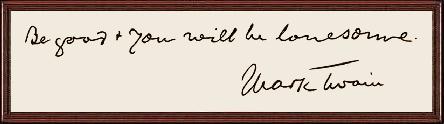
Autographed Edition


Mark Twain Quotations, Newspaper Collections, Related Resources


Lonesome quote


Quotations | Newspaper Articles | Special Features | Links | Search


A History of and Guide to
UNIFORM EDITIONS OF MARK TWAIN'S WORKS

"Whenever a Uniform and a De Luxe can be marketed, that's the time to do it; a delay of a year can be fatal, for a literary reputation is a most frail thing -- any trifling accident can kill it; and its market along with it."
- Samuel Clemens to Henry H. Rogers, 31 May 1898

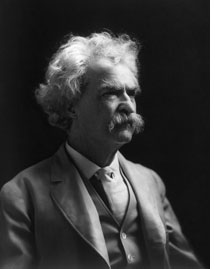
http://www.positivityblog.com/_images/080516_marktwain.jpg
Click to go to site
Mark Twain quotations

Something For the Eye: Ashi Lake, Japan (Autum)


This "Quacks" Me Up, an unbridled display of Belgium's military might.

Scientists get to the root of gray hair

SCIENTISTS have got to the root of gray hair - paving the way for locks that retain the luster of youth. 
 
grey
Scientists have made a breakthrough in grey hair research.

US researchers have identified a protein, "wnt", found to be vital to the production of colour in hairs.
The breakthrough raises the prospects of drugs, lotions or shampoos that raise levels of wnt, and restore white or grey hair to its natural colour.
Such a treatment would save women endless expensive trips to the hair salon. It doubtless also would be popular with middle-aged men keen to recapture their youthful looks.
Writing in the journal Cell, the researchers show wnt kick-starts a chain of reactions which lead to stem or "mother" cells in the scalp maturing and producing the pigment that gives hair its colour.
A similar chain of reactions takes place in the human scalp, but the researchers, from New York University's Langone Medical Centre, yet have to prove faults in the system turn people's hair grey.
Previous research showed wnt is responsible for the production of new hair follicles.
It had been thought that follicles, the tiny structures responsible for hair growth, always were formed before birth, with their gradual death leading to baldness.
Wnt, however, may not be solely to blame for greying locks. Researchers at Bradford University in England found wear and tear on our bodies leads to dangerously high levels of hydrogen peroxide building up in hair roots, blocking the production of pigment.
They said young women using hydrogen peroxide-based dyes should not necessarily worry. In older women, though, going blonde may speed up greying. It is thought genetics control if and when a person goes grey. Stress, alcohol, smoking and poor diet may accelerate the process.


Scientists get to the root of grey hair | News.com.au

The Guardian exposes the Bilderberg group in fine style

Bilderberg 2011: The tipping point

What we have learned from this year's Bilderberg conference


by Charlie Skelton


This year, Bilderberg was bigger than ever. Bigger crowds, bigger names, more coverage. So here, starting with about the least most important thing, is what I've learned from this year's Bilderberg summit in St Moritz.

I've got a bit of a crush on the Chinese vice-minister for foreign affairs

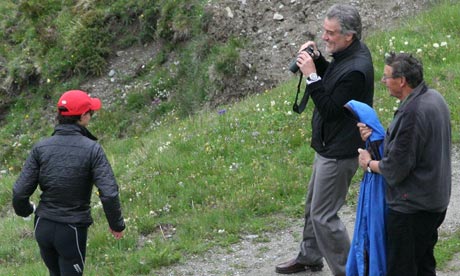
Move over Queen Beatrix. Fu Ying is my new postergirl. I can't help myself. She just seems so … fun.

Fu Ying Photograph: Quierosaber

Always hopping about, taking photos of wild flowers, pointing at the view, laughing – she's like, I don't know, a normal person or something. I look at Ying and have to wonder if China's really such an oppressive place after all. It can't be! Not with people like lovely Fu Ying running it. I think we've been misinformed. Western lies. Fu is the real China.

The BBC turned up!

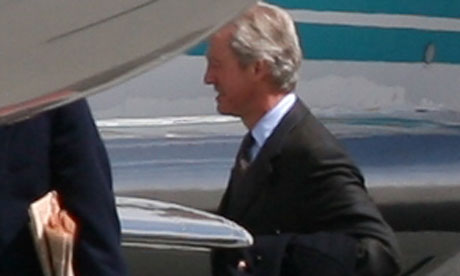
But only in the form of Marcus Agius, the senior non-executive director on the BBC's executive board. He's also chairman of Barclays, and extremely well connected. Here he is, queuing to get on a private jet home.

Marcus Agius Photograph: Alles Schall und Rauch

Also on board was Washington hawk, and one of Bilderberg's nastiest pieces of work, Richard Perle. Boy, that's someone you don't want to get stuck next to on flight. I bet he really hogs the armrest.

Bilderbergers look down on things

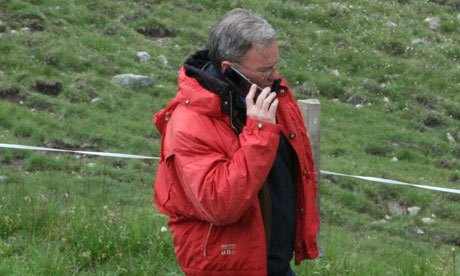
I've looked at hundreds of photos of the delegates on their nature walk through one of the world's most stunning valleys, and this is honestly the case: they don't look at the view. They walk with their heads down. They stare at their shoes. Googleboss, Eric Schmidt, was probably the least engaged with the world around him:

Eric Schmidt Photograph: Quierosaber

I know this sounds crackers, but it's really noticeable. It's heads down, as they network with grim determination. The only pair who looked up at all were Fu Ying (*SIGH*) and Loukas Tsoukalis, president of a Greek thinktank. Here he is, with his binoculars, smiling at a passing jogger.

Loukas Tsoukalis Photograph: Quierosaber

I think Tsoukalis and Fu Ying would make a good couple. I'll stand aside for the sake of international relations.

Bilderberg is the best networking event in the world

And I'm not just talking about the way it gives Douglas Flint, the head of HSBC, the chance to bend George Osborne's ear (policies). It's turned into the most extraordinary networking event for people on the other side of the security line.

I've just spent the best part of a week rubbing shoulders with a bunch of politically articulate, highly intelligent, engaged individuals: many of whom are scarily young and energetic. The character of the event has utterly changed over the last three years. The numbers have rocketed: from about a dozen in 2009, to three hundred in 2011 – and that's according to the Swiss police.

What the mainstream press have failed to do, the alternative media are simply getting on and doing. In the absence of an adequate press centre, people have formed their own. In the weird journalistic vacuum of the conference, people are newsgathering and sharing their information – and sending out bulletins to the world. It's properly inspiring, and it's only going to get bigger.

If you're simply looking to meet switched-on, clued-up people, come to Bilderberg 2012. If you want to help, observe, tweet, photograph, give legal advice, learn, share, chat, talk geo-politics, attend meetings, or just sip beer and watch the spectacle unfold, then come. The spectacle of Bilderberg is reason enough to turn up, but the people – that's where the real value is.

Email us at bilderbergmeetings@yahoo.com and come along to the summit of a lifetime.

It's been a happy conference

On Sunday, we bought a cake and a card for David Rockefeller, and delivered them to the gates of the hotel. We couldn't find a card with "Happy 96th Birthday" on the front, but we got one that showed a rainbow over the Engadine: a symbol of peace between God and humanity after the flood.

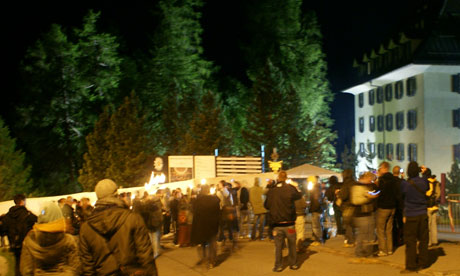
And I have to say, it's been a very peaceful conference on the outside. The activists have been picking up their litter, shaking hands with security – and the Swiss police issued a press release saying the behaviour of the crowds was "grade A". In Spain last year, it was the same: they sat in a circle on the beach and encircled the hotel with love. This year, people gathered at midnight on Saturday, with candles and lanterns, and sang birthday songs to Rockefeller.

"For he's a jolly good fellow, which nobody can deny ..."

Night crowd Photograph: Tom

I'm not saying there wasn't a note of irony in the song, but nobody threw their shoes. It was far too wet.

If you're not on the list you're not getting in

We knew that already, but this year for the first time, elected public representatives are queueing up to find out what's going on in their turf. An Italian MEP (a member of the European parliament's Committee on Civil Liberties, Justice and Home Affairs), Mario Borghezio, was beaten up and arrested by Bilderberg private security. The next day Swiss MP Dominique Baettig was denied entry for after dinner drinks. He probably had an inkling he wasn't going to share a cognac with Kissinger that evening, but it spoke volumes that he tried.

Bilderbergers don't do airport security

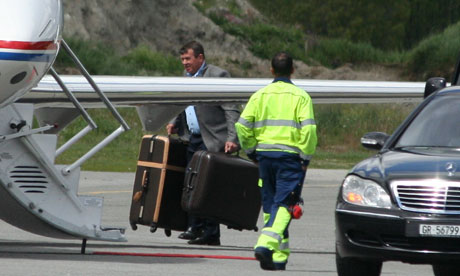
Helicopters and private jets have been haring up and down the Engadine, but with all this air traffic I shouldn't think a single Bilderbag has been scanned, let alone searched. They're barely glanced at. We watched as billionaire Alexei Mordashov's bags went from speeding people-carrier to private jet without so much as touching security:

Baggage at Bilderberg 2011 Photograph: Hannah Borno

Not that I think Alexei Mordashov has been nicking the cutlery from the conference venue in order to melt it down into car parts, but it does slightly stick in my craw that as airport security for the average citizen gets ever tighter, airport security for the likes of the oligarch Mordashov barely exists. It's a two-tier system, and to think it's ok – that it's rational, and suitable – one really has to do a lot of mindbending. The best I can do is that it's ok because he's a busy man. He's got important stuff to do. Billionaire stuff.

The rationale is basically this: you want to check his bags? Come on! Get out of the way! Billionaire coming through!

Anonymity is for Bilderbergers, not for the public

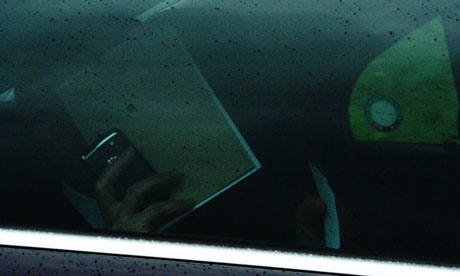
The police and secret services keep the cameras at bay. The pegged-up shower curtain hides the hotel. Blackened windows and security escorts protect the delicate, quivering participants from the horror of being identified. The coyest are never seen at all, and never make the delegate list.

Hiding delegate at Bilderberg 2011 Photograph: Paul Dorneanu/infocon.ro

Now compare that with your life. CCTV cameras with face-recognition software scan your daily life. Travel cards log your journeys. And online, you'll have noticed – particularly in the last year – how your accounts are all being linked, and how you're having to constantly prove your identity. Anonymity is a sin. Anonymity is what terrorists do.

And here's the irony. In secret, with no public oversight, a group of politicians, billionaires and corporate CEOs are discussing (we're told): Social Networks: Connectivity and Security Issues.

The global policy concerning the transparency of our social life is being thrashed out in an untransparent forum by people whose "social network" includes people like Henry Kissinger and the chairman of Goldman Sachs International. It also includes people we don't even know are there (this happens every year, names emerge that were never admitted to).

It's not wrong to want to know more

Thomas Jefferson said: "Whenever the people are well-informed, they can be trusted with their own government." And: "If once they [the people] become inattentive to the public affairs, you and I, and Congress, and Assemblies, Judges, and Governors, shall all become wolves."

Without the people's attention to government, government grows fangs; but: "Enlighten the people generally, and tyranny and oppressions of body and mind will vanish like evil spirits at the dawn of day."

And then we have Bilderberg. A massive great, sniper-armed, window-tinted, helicoptering slap in the face to any concept of enlightened democracy. Shrouded, misty and removed. A place where "Congress and Assemblies, Judges, and Governors" sit about in secret and do business with bank bosses and the chairmen of corporations, and policemen stand guard lest the citizenry become too informed.

Bilderberg is a backwards step, heading in wholly the wrong direction when "transparency of government" is something we're all clawing towards. It's a dinosaur. A childish, irritating dinosaur. It's Godzuki.

Bilderberg is the very opposite of a bulwark of a democracy, whatever the opposite of a bulwark is. (A siege engine?)

Anyone who wants to be a good Jeffersonian and be part of an enlightened populace must become attentive to public affairs, and should pay particular attention to their public officials when they're skulking about in the mist with big business. And if the press won't pay attention to it, then the citizenry must.

Fortunately for all of us, that's exactly what the citizenry are doing.

Enjoy a free internet while you can

Speaking of personality disorders – when Peter Mandelson, who pushed through the digital economy bill, sits down with Keith Alexander – the director of the NSA and head of United States Cyber Command to discuss "Social Networks: Connectivity and Security Issues" you can be pretty sure they aren't hammering out how best to preserve the freedom of the internet.

Add a liberal sprinkling of cyber power in the form of Mark Hughes (Facebook), Eric Schmidt (Google) and Craig Mundie (Microsoft) and you have the perfect formula for a lock-down. Let's hope Neelie Kroes, the European commissioner for digital agenda, got to push her "No Disconnect Strategy". I'd pay good money to have heard the head of the NSA's views on that one.

The Bilderberg website is a disgrace

The Bilderberg summit is a gathering of the richest, most powerful people in the western world. They can afford helicopters, hundreds of police, security personnel, secret servicemen, floodlights, fencing, portacabins, limousines, chauffeurs, chefs, catering, entertainment, and the hire of a massive luxury hotel for an entire week …

But they spent, what, fifty quid on their web design? Sixty tops. They haven't even proof read it.

Now, it's certainly a good and healthy sign that Bilderberg said a tentative "hello" to the world half-way through last year's meeting with its website, but it just isn't good enough.

For a start, look at the agenda. There are people who say: "Look, Bilderberg is being open and transparent! They've published exactly what they discuss! There's no secrecy here!" Then you look at what they publish. Here's a snippet:

China screengrab

So they discussed "China". Care to be a bit more specific? No – just "China". I wouldn't exactly describe their agenda as "information rich". They might as well have listed: "important stuff; things; other things; areas of interest; topics and assorted other subjects".

But more importantly, the website is full of inaccuracies, gaps, and outright lies. The delegate list is never complete, it's just a list of people who don't mind admitting they've been. Some prefer to keep their names out of Bilderberg history. (Tony Blair never admitted going, he even lied to parliament about it, although it's well documented that he attended).

Then it claims that: "Participants attend Bilderberg in a private and not an official capacity." Just not true. We know from the Treasury that Osborne has been in St Moritz in his official role as chancellor.

Then it states:

Bilderberg screengrab

But a few moments digging around documents and history books, and you realise how the Bilderberg conference actually works. The annual conference bit, whilst being hugely important, is only the "public" bit of the organisation. The steering committee (which has on it, amongst others, our lord chancellor, Kenneth Clarke MP) meets throughout the year. It's extremely active, but even more secretive still.

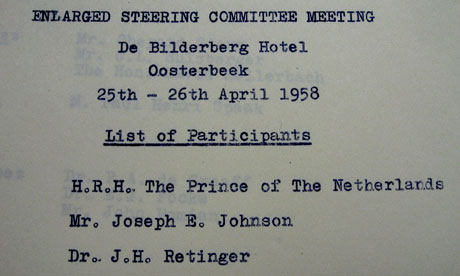
For example, see if you can find this 1958 conference of the 'Extended Steering Group' in the official Bilderberg history …

Bilderberg steering group

I notice that Sir Colin Gubbins attended. (Budding historians of Bilderberg, get Googling).

The Swiss love a bit of history

I found that many of the Swiss activists were keen to flag up (often with giant flags) the shady roots of the Bilderberg group. It's perhaps wrong to judge present delegates on Bilderberg's past, but the Swiss seemed particularly attuned to this aspect of the group's history: that it was founded in the early 1950s by Prince Bernhard of the Netherlands, a former SS officer and executive in IG Farben's notorious NW7 Berlin espionage centre. That's the IG Farben that manufactured Zyklon B and bankrolled Hitler.

Look to the hosts, and you find Bernhard's daughter Beatrix running Bilderberg, alongside "philanthropist" banker David Rockefeller and the saviour of world football (and wanted war criminal) Henry Kissinger.

Look to the delegates, and inside the same conference you've got two people with the nickname "The Prince of Darkness": Lord Mandelson, and Richard Perle (the Washington uber-hawk). Read up about the chairman of Nestlé. Then read Jon Ronson's important new book on psychopaths. Ronson has dragged a particular discourse into the mainstream without which it is pretty much impossible to understand what's going on here.

The British press simply isn't doing its job

The Swiss press have been reporting Bilderberg with gusto. Russia Today sent a film crew, the Italian media is here, Alex Jones sent a team, the Canadian Broadcasting Company are doing interviews, there's even a French journalist somewhere, I'm told.

But from Britain? Not so much.

In 2008, when George Osborne, as a private individual, hangs out in Corfu with a Russian oligarch (Oleg Deripaska), Nat Rothschild and Peter Mandelson, the British press has a field day with the gossip – Mandelson "dripping poison" about Osborne, and allegations that Osborne was grubbing around for party funds.

But in 2011, when Osborne spends four days, in his official role as chancellor of the exchequer, cooped up with Lord Mandelson, a Russian oligarch (Alexei Mordashov), and the former vice-chairman of Rothschild Europe (Franco Bernabè) – along with the president of the World Bank, the president of the European Central Bank, the Greek minister of finance, the queen of Spain, the chairman of Royal Dutch Shell, the governor of the Belgium National Bank, the chairman of Goldman Sachs International, and the chief executive of Marks and Spencer …

This isn't news.

As you might have noticed by now, I beg to differ.


Bilderberg 2011: The tipping point | World news | guardian.co.uk

The HoTTness of: Ardent Love


Aesthetically Pleasing: Moran Atias


Should the North Celebrate the Defeat of the Confederacy?

Once a year, for reasons that make sense only to them, the former Confederate States of America commemorate their participation in what they euphemistically refer to as “The War of Secession.”

This year marks the150th anniversary of the start of the Civil War (South Carolina seceded in December, 1860; the conflict began in April, 1861), and the former rebel states are planning to go all out for the next -- God help us -- four years.

Confederate flags will appear almost everywhere, battle re-enactments will take place, gala balls and parades will be held in southern cities, and the proud, delusional state of Alabama even has plans to throw a Jefferson Davis mock swearing-in ceremony, featuring a Jeff Davis look-alike.

The South is probably the only place in the world that celebrates its defeat in a war. One does not see the Germans rejoicing over the invasion of Poland; the Japanese let Pearl Harbor Day pass without fanfare; the British don’t have parties on the anniversary of the Boston Massacre.

Of course, southerners bend over backwards to assure us that the subject of slavery is somehow unrelated to the Civil War. It’s supposed to be strictly a states’ rights issue, they insist. Which is a little like saying the Spanish Inquisition was about Papal attire.

To use the southern phrase -- that dog don't hunt.

The fact that secession was also treasonous and ultimately resulted in the deaths of 620,000 Americans seems also to have escaped the selective memories of our southern brethren. Let’s not forget -- they started it.

Wake up and smell the mint juleps, y'all. The North won the war fair and square. Stop acting like you did. It's a little pathetic.

It's also offensive to just about everybody else in the nation. People protest and write angry OpEds, but every year that hateful flag finds its way out of the moth balls and into the street.

Which begs the question: Since the North actually did win the war, shouldn't we be the ones having the celebration? We could call it “Appomattox Day.” Every April 9th (the day of surrender in 1865), we could find a guy with a grayish beard, put him in a gray uniform and watch him hand his sword over to a bearded guy in a blue uniform.

We could re-enact Gettysburg and Lincoln's inaugurations; school children could sing “The Battle Hymn of the Republic.” We could have ceremonies that honor Frederick Douglass, Dred Scott, William Lloyd Garrison and John Brown.

If Southerners find this offensive, they could always stuff cotton in their ears, which seems to be what most of them did during history class.


Should the North Celebrate the Defeat of the Confederacy? - john blumenthal - Open Salon

100 Best YouTube Videos for Science Teachers

By now, YouTube’s value in the classroom should be rather self-evident. No matter the subject or grade level, the website offers up excellent videos to supplement lessons and provide windows into different facts and concepts. Science teachers especially have plenty to love and appreciate with this valuable resource. Everything from microbiology to astrophysics makes an appearance through a channel operated by a museum, university, educator, professional or interested individual. Because so many of the sciences require visual aids to really open up and explain their very cores and valuable applications.
It should be noted that this list does not contain any Mythbusters videos, as I lack any semblance of self-control and would just end up listing 100 of them instead of providing a diverse selection to meet the needs of different classrooms. Rest assured, though, that there is probably a clip from Mythbusters available to fit almost any lecture.
1.) They Might Be Giants: “Meet the Elements” (BB Video)
Boing Boing presents the single greatest animated science video on YouTube, accompanied by a catchy song about the periodic table – courtesy of the venerable They Might Be Giants.

 2.) Diet Coke + Mentos
If allowing the little nose-mining cherubs to conduct their own Diet Coke and Mentos experiments means injuries and lawsuits, then showing them the video that launched the craze will probably work as a reasonable substitute.
3.) The Science of Caddyshack
Believe it or not, the movie Caddyshack actually involves real-life science – as the Discovery Channel’s James Williams is more than eager to share.
4.) The Inner Life of the Cell
Biology teachers hoping for a wonderful visualization of cellular functioning and structure absolutely need to show off this gorgeous animated collaboration between Harvard and XVIVO. The fact that it does not involve any audio beyond some wonderfully soothing music means it can serve as a nice backdrop to a lecture.


5.) They Might Be Giants – How Many Planets?
Anyone who doesn’t wax nostalgic over the loss of dearly beloved Pluto (1930-2006. Never Forget.) probably kicks orphaned, widowed puppies in his or her spare time.
6.) Turtle Takes on a Shark
All the cheesy fun of a SyFy original movie, with the added bonus of being both real and educational!
7.) 2010 Exploring Space Lecture: Where the Hot Stuff Is: Volcanoes of the Earth and Solar System
At over 1 hour in length, this lecture on volcanism beyond the familiar structures on Earth is best presented in bits and pieces that dovetail nicely with lessons.
8.) Pistol Shrimp
Spice up a biology or ecology class with a crazy awesome video of a shrimp capable of shooting jets of water almost as hot as the surface of the sun!
9.) Killing Anthrax Faster and Greener
Killing off hearty anthrax usually eats up insane amounts of time and involves corrosive components, but a new method may prove more efficient and ecologically-friendly.


10.) “New World” Asteroid Photographed
21 Lutetia, so far, is the largest asteroid any human has yet to see up close. This amazing footage, courtesy of National Geographic and the European Space Agency, makes for a great addition to any astronomy class.
11.) They Might Be Giants – Roy G Biv
Off their “Here Comes Science” album – which, incidentally, will crop up on this list multiple times – comes a nifty little ditty about the color spectrum. Of course, it comes with a fun animated music video of its own.


12.) Edible Insects
Cultures all over the world rely on insects to provide protein and other nutrients, and the staff at the National Museum of Natural History share their thoughts on trying a food considered “gross” in Western society.
13.) Giant Double Rainbow
Discovery News sheds some light on a YouTube video involving an anomalous double rainbow, offering a cool, quick lesson in refraction and spectrum physics.
14.) Mirage 1
Robert Krampf is pretty much the Bob Ross of science, and this warm, accessible video explains the basics of how mirages work.
15.) They Might Be Giants - Speed and Velocity w/ Marty Beller
The Flash has nothing on these 2 enjoyable superheroes, who introduce lessons in the difference between speed and velocity.
16.) Earth-Building Wounds
Scientists are studying the unique geological properties of Iceland in order to better understand how tectonic plates form and shift to permanently change the shape of the planet.
17.) The Wright Brothers Discover Aspect Ratio
John D. Anderson at the National Air and Space Museum provides an interesting talk on the Wright Brothers and their indispensible contributions to the history of human flight.
18.) Through the Wormhole: DNA
Morgan Freeman(!!!!!!) narrates a brief clip on the structure and importance of DNA. Short, but soothing. Also educational. Also Morgan Freeman.


19.) Extraordinary Gorilla Encounter Explained
Learn about the reality behind Damian Aspinall’s re-introduction to a gorilla he raised 5 years prior – an interesting glimpse into primate behavior!
20.) Microwaving the World
More sensitive classes may not like thinking about the negative impact an aging sun would have on the planet, but this video still has plenty to offer science teachers whose lessons involve the lifecycles of stars.
21.) Electric Car – They Might Be Giants w/ Robin Goldwasser
Students learning about ecology and alternative energy may appreciate another wonderful installment in They Might Be Giants’s “Here Comes Science” song and video series!
22.) What Do Visitors Really Know About Evolution?
This 1-hour lecture from the National Museum of Natural History shares some of the institution’s findings
 regarding how to best educate visitors on the Theory of Evolution.


23.) Robot Controlled by Human Brainwaves
AAAAAAAAAAAAAAAAAAAAAAHHHHHHHHHHHHHHHHH!!!!!!!!!!!
24.) A Color You Can’t See
The infinitely huggable Robert Krampf explains that some colors exist outside of human perception, but cell phone cameras can help individuals see them in action.
25.) They Might Be Giants – Why Does the Sun Shine? (The Sun is a Mass of Incandescent Gas)
One of They Might Be Giants’s most famous songs just happens to have an application in the science classroom, particularly those involving astronomy.
26.) The Medical Heroin Experiment
Educators who enjoy facilitating civil debates in their science classrooms may like this National Geographic video on the medical heroin controversy as a conversation starter.
27.) NASA Android Testing
In the 1960’s, NASA experimented with android robotics for possible space suit applications. They donated their footage (and the metal man himself) to the National Air and Space Museum to educate the populace on their findings.
28.) What is Synthetic Genomics?
Receive a crash course in how cells work and the field of synthetic genomics that has sprung up around them.
29.) Why is the Sky Blue?
Such a simple question actually has an interesting, complex answer involving spectrum physics!
30.) Big Cats Wild for Calvin Klein Cologne?
This humorous video showcases some very unusually findings by the Wildlife Conservation Society regarding how cheetahs react to Calvin Klein’s “Obsession for Men.”
31.) King Weed – They Might Be Giants
Throw a couple of suited men into a biology class for a neat musical discussion of evolution and survival of the fittest.
32.) Smithsonian geologist puts Eyjafjallajökull eruption in perspective
Energetic geologist Liz Cottrell analyzes a particularly infamous volcanic eruption and illustrates what it means for the planet’s structure.
33.) Ticks: Bloodsucking Ninjas of Summer
This useful video talks ticks, both their biology, the diseases they carry and how to prevent a negative encounter with these little Nasty Nellies.
34.) Making Butter
One of the first science experiments most children undertake in their educations involves turning cream into butter, deliciously illustrating different states of matter.
35.) They Might Be Giants – Computer Assisted Design
Listen to a neat song and watch a great animation on what technology can do to help mankind channel its creativity and solve serious problems.
36.) Amazing Northern Lights
Marvel at one of the most breathtaking meteorological occurrences, where lights in every color of the rainbow dance across the sky in smooth, elegant waves.
37.) Apollo 11 TV Broadcast – Neil Armstrong First Step on Moon
Watch one of the most triumphant moments in human history as Neil Armstrong becomes the first man to set foot on Earth’s moon.
38.) Sci Fi Science: Traveling at Warp Speed
Believe it or not, 1 mathematical equation may unlock the reality behind the currently fictitious concept of traveling through space and time without violating any known laws of physics.
39.) Cuttlefish: Chameleons of the Sea
The intelligent, gentle cuttlefish possesses the amazing ability to change both its color and its texture to fit the environment in which it feeds.
40.) Electromagnetic Sun Storms
Although the likelihood of such a deadly cavalcade of electromagnetism is minimal, the sun still holds the potential to wipe out human infrastructure with a particularly heavy burst.
41.) Photosynthesis – They Might Be Giants
Introduce classes to the fundamentals of photosynthesis with another delightful video by They Might Be Giants.
42.) Recreating Volcanoes in a Lab
Follow Liz Cottrell as she shows off the equipment she uses to study volcanoes without ever even leaving her lab.
43.) Sea Otter Poop May Help Save Species
Perfect for ecology and biology classes, this hopeful little video full of spunky l’il otters, information on nurturing their population growth and – of course – plenty of doo-doo.
44.) The Science of Balance
Robert Krampf talks about the relationship between gravity and balance, with plenty of simple, effective demonstrations to prove his point.
45.) I Am a Paleontologist – They Might Be Giants w/Danny Weinkauf
This video wraps up 3 things kids love into one catchy package – dinosaurs, music and not having to stare slack-jawed and disengaged during a lecture.


46.) Dropping 2 Million Pounds
Human engineering and construction has evolved to the point it can pick up a bridge weighing 2 million pounds and (very carefully!) haul it to a new location.
47.) Primordial Soup With Julia Child
The amazing, incomparable Julia Child lends her cooking skills to science education, mixing up a hearty brew of amino acids and discussing how integral they are to all life on Earth.
48.) Popular Science’s Future Of: Pleasure
One fun, enjoyable little robot has been programmed to improvise music and work with humans to improve their talents together and create some amazing songs.
49.) Smart Tech Measures Personal Water Consumption
Hydrosense, developed by the University of Washington, allows individuals to track how much water they use in a day – a useful little device for the ecologically-minded! Perhaps the ecologically-minded classroom?
50.) Twin Super Powers
The Hogans, a pair of twins joined at the cranium, possess an amazing cognitive and sensory ability to see and understand stimuli simultaneously – even if only one of the kids actually sees it.
51.) Solid Liquid Gas – They Might Be Giants
Another rocking time with They Might Be Giants, teaching kids the 3 basic forms of matter and how materials transition between them.
52.) Skeletal Growth- Smithsonian National Museum of Natural History in Washington, D.C.
Watch a brief animated video on how the magnificent human skeleton gradually grows from only 1 day old into adulthood.
53.) Star Spits Out Baby Planet
Punch up on astronomy lessons by showing a Discovery News video explaining – in layman’s terms – how debris from a star gradually creates planets.
54.) Static Charges
Experiment with static electricity alongside the lovely Robert Krampf and learn a few lessons about induction along the way.
55.) Brink – Space Junk
Internet celebrities Rhett & Link sing a catchy song about the manmade clutter that floats about the Earth’s orbit.
56.) Monsters of the Deep
The hugest bivalves in existence, the giant clams sit gently on the seafloor and continue to fascinate scientists for reasons other than their generous size.
57.) Let’s Go For A Spin: Lunar Rovers of Apollo and Constellation
Listen to a fascinating lecture on the latest developments in rover technology and the machinery’s importance to advancing humanity’s knowledge of outer space.
58.) The Nerdabout vlog – How to Hack a Wii Remote
Micro-controllers such as the Wii remote provide some very cool, very basic computing lessons.
59.) Is It Possible? Real Life Batman
Daniel Kish has been blind since the age of 13 months, but gets around almost as well as those with sight using flash sonar and echolocation. Really more of a Daredevil than a Batman, he “sees” with his ears by sending out clicks and measuring their echoes in order to form a “picture” of his surroundings.
60.) Dream Car Archaeology
Engineering classrooms – most especially those populated by gearheads – can find both entertainment and education in this cool National Geographic video of a restoration team working on a ’54 Oldsmobile. Considering the vehicle’s age, they have to piece together different clues and use logic and experimentation to find out what will and will not work.
61.) What Is a Shooting Star? – They Might Be Giants
Astronomy students sometimes struggle with the difference between meteors and meteorites, but enough rounds of They Might Be Giants’s catchy vocabulary lesson can set them straight.
62.) Coral Reefs – A Delicate Balance of Life at the National Museum of Natural History
This video offering by NMNH provides educators with some dramatic images of its coral reef exhibit, and the lack of narration makes it a nice backdrop for lectures on ocean life.
63.) Hawaii Volcano Shows Technicolor Lava
One of the most fascinating geological phenomena on the planet comes to life through infrared imaging, and Discovery News uses the available footage to discuss how scientists use the information to predict eruptions.
64.) Feathers
Explore the ins and outs of fabulous feathers, which contain a multitude of marvels beneath their simple surfaces.
65.) Mammals Vs. Dinos- Mammalian Sensory Development
Learn about the ways in which nocturnal behavior contributed to the perpetuation and evolution of different mammalian species.
66.) Nuclear Explosion in the Sky
Contrary to what many believe, explosives do not have to be dropped on a city in order to disrupt life and dismantle infrastructures.
67.) How Things Fly Exhibition – Blended Wing Body
Take a quick peek into NASA’s experiments in blended wing aircraft and learn a little bit about how they may end up increasing the efficiency of aeronautic vehicles.
68.) Visions of the Future: Intelligent Driving
“Computer power doubles every 18 months,” states this video by the Science Channel. Already, scientists are in a place conducive to designing and testing cars capable of driving themselves!
69.) SDO Captures Eruptions on the Sun
Witness dramatic solar activity recorded by SDO and learn about how the surface of the sun constantly changes.
70.) Slicing Up the Bay Bridge
Physics and engineering students curious about the real-world applications of their lessons may appreciate learning about the challenging repairs that construction workers faced when making the Bay Bridge safer.
71.) They Might Be Giants – Cells
As if the band hasn’t already provided a bevy of great songs and videos for science teachers, They Might Be Giants chimes in with a useful lesson on cellular fundamentals.
72.) Lessons from the Panama Oil Spill
Learn what Dr. Jeremy Jackson at the Scripps Center for Oceanography has to say about how humanity should react to horrifying oil spills based on past experiences.
73.) Why is it So Hard to Lose Weight?
This incredibly valuable video discusses biology, evolution, nutrition and anatomy while also teaching the healthiest method of losing weight.
74.) Solar Power
Solar power plants who use mirrors to capture energy provide some great lessons in how light reflection and refraction work.
75.) It’s All Geek to Me – Vinyl to Digital
David Pogue for the New York Times demonstrates how recording studios transfer music from old vinyl albums to digital media so as not to lose any classics.
76.) Extraordinary Adaptation
Dystonia causes sufferers to perpetually flex up to 500 muscles at once, and Jason Dunn opens up about what life is like with “one of the most annoying things you can imagine.”
77.) Apollo and the So-Called Moon-Landing Hoax
National Air and Space Museum’s curator of Space History Dr. Roger Launius dispels some of the conspiracy theories behind the first moon landing.
78.) Space School- Earth
Thus far, Earth has proven one of the most unique planets in the universe…and definitely the Solar System! Learn about the special properties it possesses that allows life to teem on its surface.
79.) Chimps Face Death Like Humans Do
Several studies have conducted research on how chimpanzees deal with the death of their friends and relatives, and the revelations have come as something of a shock.
80.) Why Geography Matters by Google Earth
Geography encompasses a wide array of subjects, and kids participating in the 2010 National Geographic Bee explain why they believe it’s so important to study.
81.) My Brother the Ape – They Might Be Giants
Teachers allowed to discuss evolution in their classrooms can play this They Might Be Giants video to illustrate the interconnectivity of different animals – including humans!
82.) Science with an Artistic Flair at the Smithsonian’s National Museum of Natural History
Enjoy some of the impressive portfolios from NMNH’s scientific illustrators, who merge the technical with the creative on a daily basis. To incredible results, no less!
83.) Stressed Veggies Better For You
Learn about the biological phenomena that cause cut vegetables to yield greater nutrients – useful lessons for a couple of different scientific disciplines!


84.) Pictures in Silver
The dying art of film photography seamlessly blends art with chemistry, and Robert Krampf shares a characteristically chill experiment explaining how the process works.
85.) The Physics of Baseball – Pitching
America’s allegedly favorite pastime possesses myriad opportunities for teachers to illustrate some of the basic principles of physics.
86.) Alpaca Fleece to Help in Gulf Oil Spill?
Ecology, geography, geology and biology converge in this interesting glimpse at how 4 alpacas at the Alabama Gulf Coast Zoo are contributing to cleaning up the 2010 BP oil spill – a handy lesson that transcends time and date.
87.) Big Blue Sky: The History of Hang Gliding
Physics and engineering classes may enjoy hearing some parts of Bill Liscomb’s neat lecture on the history of hang gliding.
88.) Beyond Tomorrow- Mercedes Brakes
The sleek, sexy Mercedes possesses some advanced technology capable of helping drivers use their breaks more efficiently and safely.
89.) LHC Collides at Record Speeds
CERN’s undeniably ambitious Large Hadron Collider may change the face of particle physics and its associated fields forever, and Discovery Channel provides a quick overview of what scientists hope it will accomplish.
90.) Frog Jumps Caught in Slow Motion
Watch some amazing high-speed footage of frogs jumping in order to learn more about how their complex little bodies work.
91.) They Might Be Giants – The Bloodmobile
They Might Be Giants use their prodigious musical talents to sing about how the circulatory system interacts with other organs to keep a body running smoothly.
92.) Oxygen
Styled like a PSA from the ‘50s, this fun animated video by the National Museum of Natural History teaches viewers how fundamental this element is to the survival of life on Earth.
93.) Synthetic Life Becomes Reality
The J. Craig Venter Institute has developed a revolutionary procedure that will change the face of biology and biotechnology forever – a fully-functioning cell constructed entirely of synthetic DNA.
94.) The Waterfall Effect
Waterfalls provide an extremely interesting opportunity to learn about the relationship between perception and cognition.
95.) Heavy Metal Task Force: Ice Hammer
Ice hammers are amazing machines that allow humans to keep water sources from freezing over too much. These feats of engineering involve incredibly dangerous maneuvers and require the most precise science available.
96.) Understanding Earthquakes
Subterranean events comprise the vast majority of Earth’s activity, and this video explains the science behind one of the most common (and devastating) effects they have on the crust.
97.) Space Shuttle STS-129 Astronauts Visit the Museum
The National Air and Space Museum presents a 1-hour lecture and Q&A session with the 4 astronauts who traveled to the International Space Station on the STS-129.
98.) Physics of Superheroes 1 – Death of Gwen Stacy
University of Minnesota physics professor Dr. James Kakalios presents a very cool series of lectures – all of which are available on YouTube – on the real-life science behind many comic book stories and characters.
99.) Is It Possible?- Personal Jet Pack
Although still in the testing phase, engineering has begun fulfilling some of the promises Hanna-Barbera made with The Jetsons.
100.) They Might Be Giants – Put It to the Test
Marvel as little 8-bit men sing viewers through the different steps of the scientific method.
Videos make for an amazing way to add interest to a lecture and encourage students to better understand the concepts and applications of the sciences. Consider punching up a lesson by infusing multimedia into the classroom, opening up the minds of children and adults alike and allowing them to comprehend the complex ways that the universe works.


Bachelor Of Science » 100 Best YouTube Videos for Science Teachers